
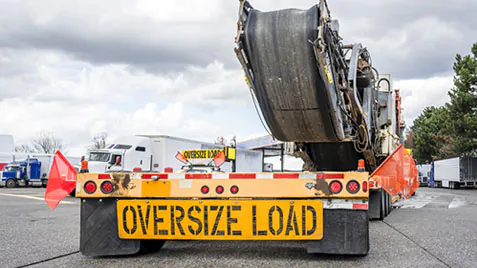
A practical checklist for planning oversized shipments with permits, route surveys, clearance checks, and cross-border considerations.
Oversized shipments are not “standard freight, but bigger.” Once a load exceeds legal limits for width, height, length, or weight, the move often becomes permit-driven and route-driven. In Canada, oversize/overweight permitting is largely handled at the provincial/territorial level, and requirements can vary by route and local restrictions.
A quick definition helps. An oversize/overweight permit is an authorization to move beyond legal limits, usually with conditions like approved routes, travel windows, or escort requirements. Ontario’s official single-trip permit instructions, for example, state that carriers must apply at least 3 business days before the move date.
Why Oversized Shipments Need Route-First Planning
For oversized shipments, the “best route” is often the one that avoids constraints, not the one that looks shortest. Bridge clearances, restricted turns, work zones, and staging areas can determine feasibility. British Columbia’s Commercial Transport Procedures Manual includes transportation management plan templates that call for a turn-by-turn route, plus listing restricted clearances and suitable pullouts—exactly the kind of detail that prevents last-minute surprises.
Cross-border moves add another layer. The U.S. federal government does not issue oversize/overweight permits—this is handled by states—so Canada–US shipments require a “two rulebooks” mindset.
What To Confirm Before Booking Oversized Shipments
1) Measurements that match the loaded configuration
Record cargo length, width, height, and weight including packaging and dunnage. Trailer choice (deck height) and how the load sits can change total height and trigger different routes or permit conditions.
2) Permit lead times and routing assumptions
Build the schedule around permit lead times and route feasibility. Ontario’s single-trip instructions explicitly set a minimum application window (3 business days). If routing changes after applying, permit details may need rework.
3) A route survey that checks “real-world blockers”
A strong route survey for oversized shipments typically checks:
- Restricted clearances (bridges, overheads, signs, utilities)
- Turning geometry (tight corners, roundabouts, gate access)
- Construction and detours (known closures and alternates)
- Pullouts and safe stops (for checks and coordination)
BC’s manual highlights documenting these items in planning templates for extraordinary/heavy haul moves.
4) Safety compliance vs oversize permits
Permits are not the same as carrier safety oversight. In Canada, the National Safety Code (NSC) is a set of minimum performance standards for commercial vehicle safety (drivers, vehicles, carriers). It complements—but does not replace—provincial oversize permitting.
Common Permit Conditions to Expect
While conditions vary by jurisdiction and route, oversized shipments commonly face:
- Route limitations (approved corridors)
- Time-of-day / day-of-week travel rules
- Signage/lighting requirements
- Escort requirements (where triggered)
- Seasonal or event restrictions
FAQ
Often, yes—once legal dimension or weight limits are exceeded. The exact trigger and conditions vary by province/route, so confirming thresholds early matters.
Ontario’s official instructions say carriers must apply at least 3 business days before the proposed move date.
Canada permits are generally provincial/territorial; in the U.S., oversize/overweight permits are issued by states, not the federal government.
Next Steps for Readers Planning an Oversize Move
For a practical overview of how oversize freight is planned end to end, read our Guide to Over Dimensional Shipping
For equipment, routing, and coordination details, review our service page.
When a shipment scope is defined (dimensions, weight, lanes, and timing), request a quote.